
What electricians need from solar lighting design for reliable results
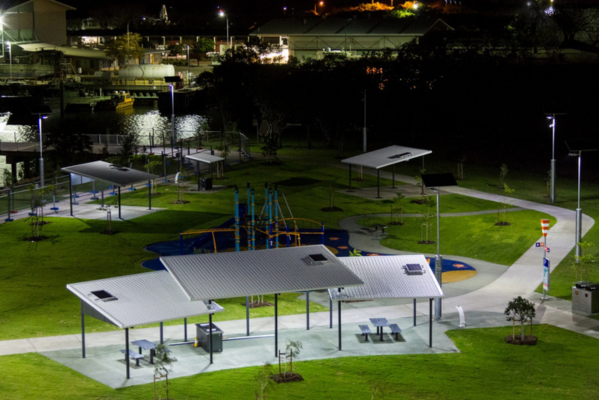
Lighting design is essential before any installation. Jamie Janides explores the key factors to consider on a job and why they matter.
Ask any electrician who has been called back to a pathway, car park or public reserve after a solar lighting install didn’t perform as expected and they’ll usually say the same thing: Most call-backs aren’t about the install itself. They’re about a system that was never going to work properly at that site.
ADVERTISEMENT
In the solar lighting space, the visible part of the job is the pole and luminaire. But the real performance of that system depends entirely on the engineering that happens long before a pole goes in the ground.
And that’s why, at Orca Solar Lighting, we’ve built our business on delivering complete lighting solutions, not boxes of solar lights. It’s also why we invest in complementary lighting design for every project and why we have two full-time lighting designers on our team.
For electricians and electrical contractors, this design work is what determines whether the install meets standards, performs consistently and avoids the kind of surprises that lead to rework or client dissatisfaction.
Lighting design is the part you don’t see, but it’s what makes or breaks the job.
Why proper lighting design matters to electricians
For many electricians installing solar lighting, the system arrives on site as a finished package. This includes the pole, solar panel, battery enclosure, luminaire and control system, all supplied ready for installation. But whether that system performs as expected depends entirely on the design behind it.
If a site ends up with:
- Patchy illumination
- Lights that dim out too early in winter
- Systems that don’t meet required lux levels
That’s not something an electrician can fix after installation. It is built into the design.
And because your customers look to you for answers, the responsibility often falls on the contractor, even when the root cause is a system that wasn’t designed for the location.
Good lighting design removes this risk. It gives electricians a clear plan, accurate spacing, correct system configuration and confidence that the install will perform as intended.
A solar lighting system is only as good as its design
Solar lighting is not a one-size-fits-all product. Two pathways that look identical on paper can require completely different lighting designs depending on location, shading, soil conditions, environmental factors and compliance needs.
At Orca, we engineer every project from the ground up to suit its exact site. This ensures electricians receive systems that will work reliably from day one.
- Designed for the geographical location
Every lighting design considers:
- Sun exposure and seasonal variation
- Localised shading
- Latitude-specific night duration
- Climate and temperature extremes
- The direction each pole and solar panel needs to face
This is especially critical in winter when solar autonomy is tested. Programming is built around real conditions, not assumptions.
- Designed for the application
Pathways, parks, car parks, bikeways, jetties and shared spaces all have different lighting requirements. We factor in:
- Required lux levels
- Uniformity between poles
- Pole height
- Beam distribution
- Usage patterns
Consistent, predictable illumination is a safety expectation and it is one of the things your customers notice most.
- Designed for longevity and reliability
Our lighting designers program every system before it leaves our facility. This includes:
- Output levels
- Dimming profiles
- Autonomy and backup nights
- Seasonal variance
For electricians, this means the system arrives ready to install. It is already set up for the site’s solar resource and performance needs.
Spacing, pole locations and lux uniformity, what electricians need most
Uneven lighting, incorrect pole locations or underlit sections don’t just reflect poorly on the system. They reflect on the installer. Accurate lighting design provides:
- The exact number of poles
- Precise spacing between each pole
- Locations marked on a site plan
- Lux levels between poles
- Compliance with Australian and New Zealand standards
Uniformity is one of the most common failure points in solar lighting. When a pathway is bright directly under the pole but dark between poles, the result looks inconsistent and unsafe, and your customers will notice. Proper design eliminates this problem before the job begins.
Soil conditions affect installation and must be part of the design
It’s not until you’re on site digging the footing that you fully understand the soil conditions. But if soil type hasn’t been accounted for in the design, the footing may be wrong and the installation becomes harder than it needs to be.
Soil types can include:
- Sand
- Clay
- Gravel
- Bedrock
- Reactive soils
Each requires different footing depths and construction methods.
A complete solution includes this from the start, so electricians can install with certainty instead of improvising on the day.
Compliance is non-negotiable and it starts with the design
Public spaces and commercial projects increasingly require compliance with AS/NZS lighting standards. This includes:
- Minimum lux levels
- Uniformity ratios
- Pole spacing
- Safety considerations
- Environmental performance
Compliance cannot be fixed at installation. It must be engineered from the beginning.
By ensuring nothing is ever underlit or underspecified, electricians get a system they can trust to meet the required standards without compromise and deliver the outcome their customers expect.
Support that continues after the poles are installed
Even with a comprehensive design package, we know things can change once contractors are on site. That’s why our support extends beyond the design stage. We assist electricians with:
- Installation guidance
- Clarification on footing depths
- Adjustments if pole locations shift
- Reprogramming if site conditions evolve
- Troubleshooting and after-sales support
Our goal is simple. Give electricians the confidence that the system will work as intended, and be there if adjustments are needed.
A well-designed solar lighting system makes your work look good
Electricians take pride in delivering installs that are safe, compliant and reliable. And the truth is simple. A solar lighting system performs only as well as the design behind it.
When the spacing is right, the programming is correct, the system matches the site conditions and compliance is assured, electricians get:
- Fewer call-backs
- Smoother installations
- Clearer plans
- Predictable performance
- Happy customers
- A result they’re proud to put their name to
That’s why Orca Solar Lighting focuses on delivering complete solutions, not just solar lights. The design, the part you don’t see, is what makes or breaks the job.
-
ADVERTISEMENT
-
ADVERTISEMENT
