
UNSW study finds up to 20% of solar panels degrade far faster than expected
Research from UNSW has found that around one in five solar panels degrade significantly faster than expected, with some systems potentially lasting only half of their anticipated lifespan.
After analysing performance data from nearly 11,000 photovoltaic systems worldwide, researchers identified a “long tail” in degradation rates. While the average system loses about 0.9% of output per year, up to 20% of panels degrade at least 1.5 times faster and around one in 12 degrade twice as fast.
ADVERTISEMENT
Lead author Yang Tang says this has serious implications for system longevity: “Most solar systems are designed to last around 25 years, based on their warranty period.”
“But at least one in five systems degrade much faster than the typical rate and roughly one in 12 degrade twice as fast. This means some systems could lose about 45% of their output by the 25-year mark or reach the end of their useful life in as little as 11 years.”
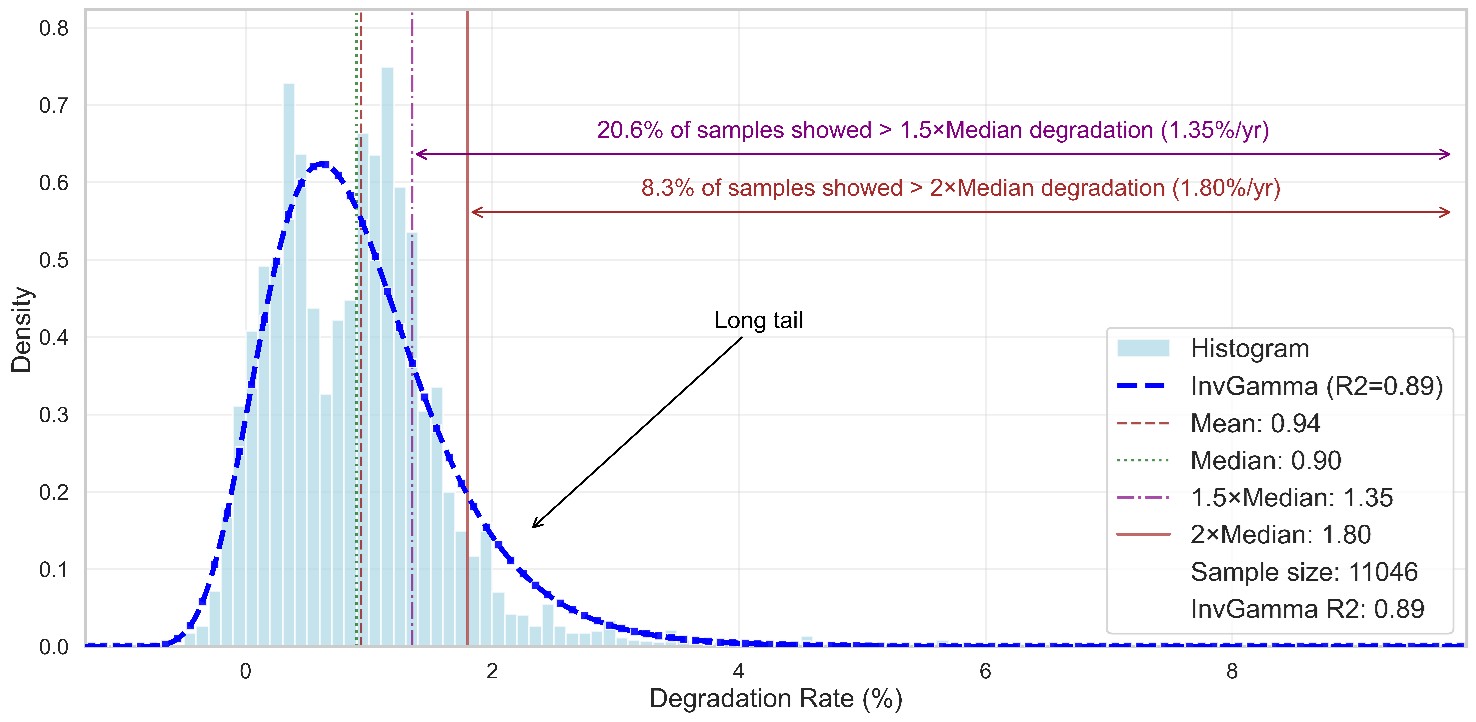
The study drew on global production data compiled by the US National Renewable Energy Laboratory and found that the accelerated degradation is not linked to climate conditions, including extreme heat. Instead, the researchers identified three main causes.
The first is interconnected failures, where one fault triggers others. For example, back sheet damage can allow moisture ingress, leading to junction box failure, corrosion or cell cracking, accelerating overall degradation.
The second is so-called infant mortality, where panels fail early due to manufacturing or material defects that are not detected during quality control.
The third involves minor defects, such as hairline cell cracks or imperfect soldering, that remain dormant before causing sudden and severe performance loss later in a panel’s life.
“When modules are operating in real-world conditions, many different factors are coming into play and cascading failures can be very significant. We need to start thinking about different testing standards that help ensure more resilient module designs,” Co-author Dr Shukla Poddar says.
The researchers say the long-tail effect poses a financial risk for large solar farms, where early failures across thousands of panels can undermine long-term energy yield forecasts and increase maintenance and replacement costs. They hope the findings will inform improved testing methods, earlier fault detection and more robust solar panel design.
-
ADVERTISEMENT
-
ADVERTISEMENT
